
 FREE PATTERN Beginner
Amigurumi Plushies & Scaling Architecture
Free Amigurumi Crochet Patterns: Animals, Characters & Plush Toys
Over 830 free step-by-step amigurumi patterns, mathematical toy resizers, and safety eye calibration tools.
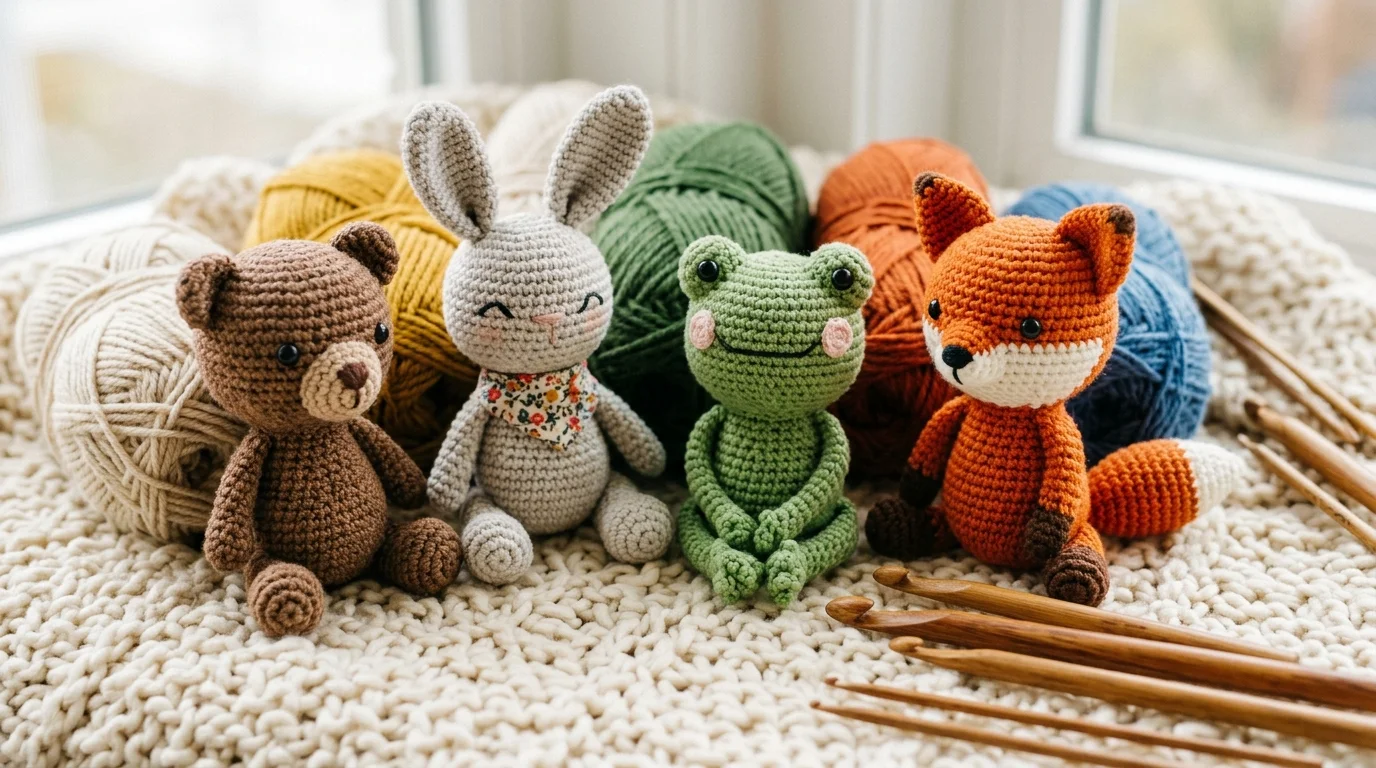
Amigurumi Silo
Entity Node: Amigurumi (Q471017) 830+ Free Designs
in
in
yd
g
Interactive Amigurumi Proportional Scaling & Safety Eye Calculator
Position #0 Direct Answer
The Ideacrochet Amigurumi Library features over 830 free step-by-step crochet patterns for plush animals, fantasy creatures, pop-culture icons, and miniature keychains. Every pattern provides complete stitch-by-step instructions, Craft Yarn Council (CYC) yarn pairings, calibrated safety eye sizing (1.5mm per inch of height), and zero-leak stuffing formulas for seamless crafting.
Scaling an amigurumi pattern from a tiny 3-inch keychain into a huggable 12-inch plush toy requires more than simply using a larger hook. Crafters must account for Quadratic Yarn Scaling (S^2) across exterior surface stitches and Cubic Stuffing Mass (S^3) in the internal cavity. Use our tool above to compute precise Toy Proportions before embarking on your make, or use our universal crochet calculator for blankets, wearables, and yardage estimation.
Amigurumi construction relies on continuous spiral rounds rather than joined rows with slip stitches. Working continuously eliminates the conspicuous, crooked vertical seam line that often mars the back of round heads and animal bodies. When working in spirals, place a locking stitch marker or a contrasting scrap of yarn into the first stitch of every round, moving it up with each progression to maintain stitch counts with total accuracy across every round.
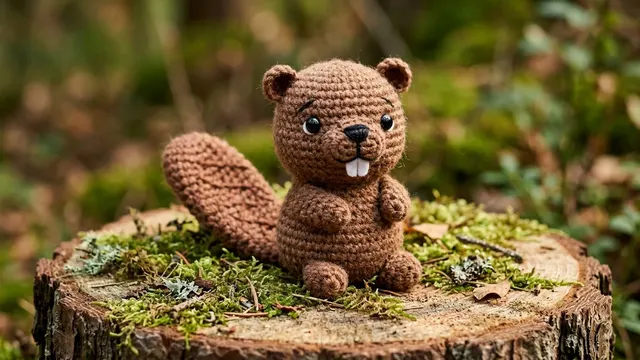
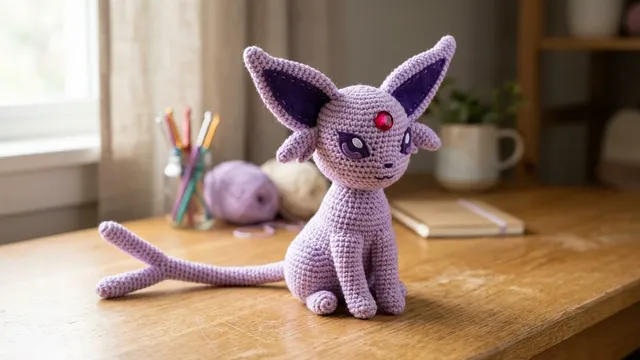
Curated Amigurumi Pattern Silo: Woodland Animals, Fantasy & Pop Culture
The Quadratic Surface & Cubic Stuffing Law: Why Linear Toy Scaling Fails
When crafters double the height of an amigurumi toy (scale factor S = 2.0), common intuition suggests doubling the yarn (2×) and Polyfill Fiberfill (2×). In physics and topology, however, stitch surface area scales as S² (2² = 4×), while interior volume scales as S³ (2³ = 8×). Buying only double the yarn guarantees running out midway through the body, while buying only double the stuffing results in a saggy, under-stuffed toy that cannot sit upright or hold its facial contour.
Similarly, safety eye proportions and Locking Washers must scale harmoniously with facial surface area. Placing small 9mm eyes designed for a 6-inch miniature onto an upsized 14-inch Pop Culture Crochet character plushie creates an awkward expression. Our calibrated ratio of 1.5mm pupil diameter per finished inch preserves the authentic Japanese kawaii aesthetic across miniature, standard, and oversized builds.
TOPOLOGICAL SCALING LAW Physical Fiber Volume & Surface Metric
Amigurumi Proportional Scaling Physics
Y_{ ext{scaled}} = Y_{ ext{base}} imes S^2, quad M_{ ext{stuffing}} = M_{ ext{base}} imes S^3
Notation: Scaled Yarn = Base Yarn × S²; Scaled Polyfill Mass = Base Stuffing × S³
Variable Definition & Units
S
Scaling Factor [ratio]
Target Height ÷ Original Pattern Height
Y_{\text{scaled}}
Scaled Yarn [yd]
Base Yarn × S² (quadratic surface law)
M_{\text{stuffing}}
Polyfill Mass [g]
Base Stuffing × S³ (cubic volume law)
D_{\text{eye}}
Eye Diameter [mm]
Target Height (in) × 1.5 mm/in snapped to market size
Calibrated Example:
Scaling a 6″ plush (85 yd yarn, 35 g polyfill) to 12″ (S = 2.0): Scaled Yarn = 85 × 4.0 = 340.0 yd. Scaled Stuffing = 35 × 8.0 = 280.0 g. Eye Diameter = 12 × 1.5 = 18 mm.
Yarn Fiber Selection & Stitch Mechanics: Yarn Under (YU) vs Yarn Over (YO)
The choice of fiber dictates the structural integrity and longevity of any amigurumi creation. Mercerized cotton (such as CYC #2 Fine or CYC #4 Worsted) delivers superior stitch definition, zero halo fuzz, and impervious tensile strength, making it ideal for collectibles and sensory toys. Premium worsted acrylic offers pliable stretch and vibrant saturation for character dolls, while polyester chenille and blanket yarns create ultra-plush velvet figures but require loose tension control to prevent thread shedding during magic loop cinching.
Professional amigurumi designers frequently implement the "Yarn Under" (YU) technique on the first pull-through, followed by a standard Yarn Over (YO) to finish the single crochet stitch. This hybrid motion forms a compact cross-shaped stitch (the "X-stitch") rather than the traditional V-shaped stitch. The X-stitch aligns stitches into clean, stacked vertical columns, dramatically reducing micro-gaps between rows and completely blocking white polyester stuffing fibers from showing through dark or saturated fabrics.
Safety eye attachment requires rigorous mechanical verification under child safety protocols. Always position Locking Washers firmly over the ribbed post. For infants under three years, replace plastic post eyes with embroidered French knots to eliminate choking hazards.
Stuffing Distribution & Gentle Plushie Maintenance
Stuffing distribution is critical: never insert large, dense clumps of Polyfill Fiberfill into a small opening. Instead, tease the polyester fibers into lightweight, cloud-like wisps and pack them incrementally using a blunt chopstick or surgical hemostat. Pack outer contours firmly to mold cheeks and muzzles, while maintaining balanced core density so the doll feels soft yet retains structural resilience against compression.
Laundering finished amigurumi requires gentle surface spot-cleaning using cold water and mild pH-neutral wool wash. Never submerge plush toys with cardboard base stabilizers or squeakers directly in hot wash cycles. For full machine laundering of acrylic toys, place the plush inside a mesh delicates laundry bag, run on a gentle hand-wash cycle, and allow it to dry flat away from direct heat radiators.
Essential Amigurumi Techniques: Magic Ring, Invisible Decrease & Seamless Assembly
1. The Magic Ring (MR)
The magic ring creates an adjustable loop that pulls completely closed, eliminating the unsightly hole at the crown of heads and limbs. It prevents stuffing from peeking out of your initial foundation round.
2. Invisible Decrease (invdec)
Working decreases through the front loops only (FLO) prevents bulky horizontal ridge bars, ensuring continuous smooth spherical shaping across muzzles, cheeks, animal paws, and contoured bodies.
3. Seamless Pin Placement
Always pin ears, arms, and tails symmetrically using glass-head sewing pins before seaming. Check facial alignment from multiple three-dimensional angles to ensure authentic character expressions.
Looking for specific animal projects? Try our popular amigurumi gingerbread man or dive into the complete crochet beaver tutorial and espeon amigurumi tutorial.
Frequently Asked Questions About Making Amigurumi Plushies
What is the best crochet stitch for amigurumi?
Single crochet (sc) worked in continuous spiral rounds is the universal standard for amigurumi. It produces a dense, tight fabric that prevents polyfill stuffing from showing or leaking through stitches.
How do I choose the correct safety eye size for my amigurumi?
A reliable formula for amigurumi safety eyes is 1.5mm of eye diameter per inch of finished toy height. For example, a 6-inch plush uses 9mm or 10mm eyes, while a 12-inch giant plush requires 18mm safety eyes.
What hook size should I use for amigurumi with worsted weight yarn?
For CYC #4 Worsted yarn, standard garments use 5.0mm (H-8) hooks, but amigurumi requires downsizing to a 3.25mm (D-3) or 3.50mm (E-4) hook to ensure tight, firm stitches that hold stuffing securely.
How do I make an invisible decrease (invdec)?
Insert hook into the front loop only (FLO) of the first stitch, then immediately insert hook into the front loop only of the second stitch. Yarn over, pull through both front loops, yarn over, and pull through the remaining two loops on hook.