Ideacrochet
Ideacrochet Free Patterns & Universal Yardage Engine
Dimensional Textile & Quilting Masterclass

Folded Star Quilt Block Tutorial: Step-by-Step Dimensional Pattern

Comprehensive step-by-step photographic guide to cutting, folding prairie points, and layering concentric dimensional star points for hot pads and pillows.

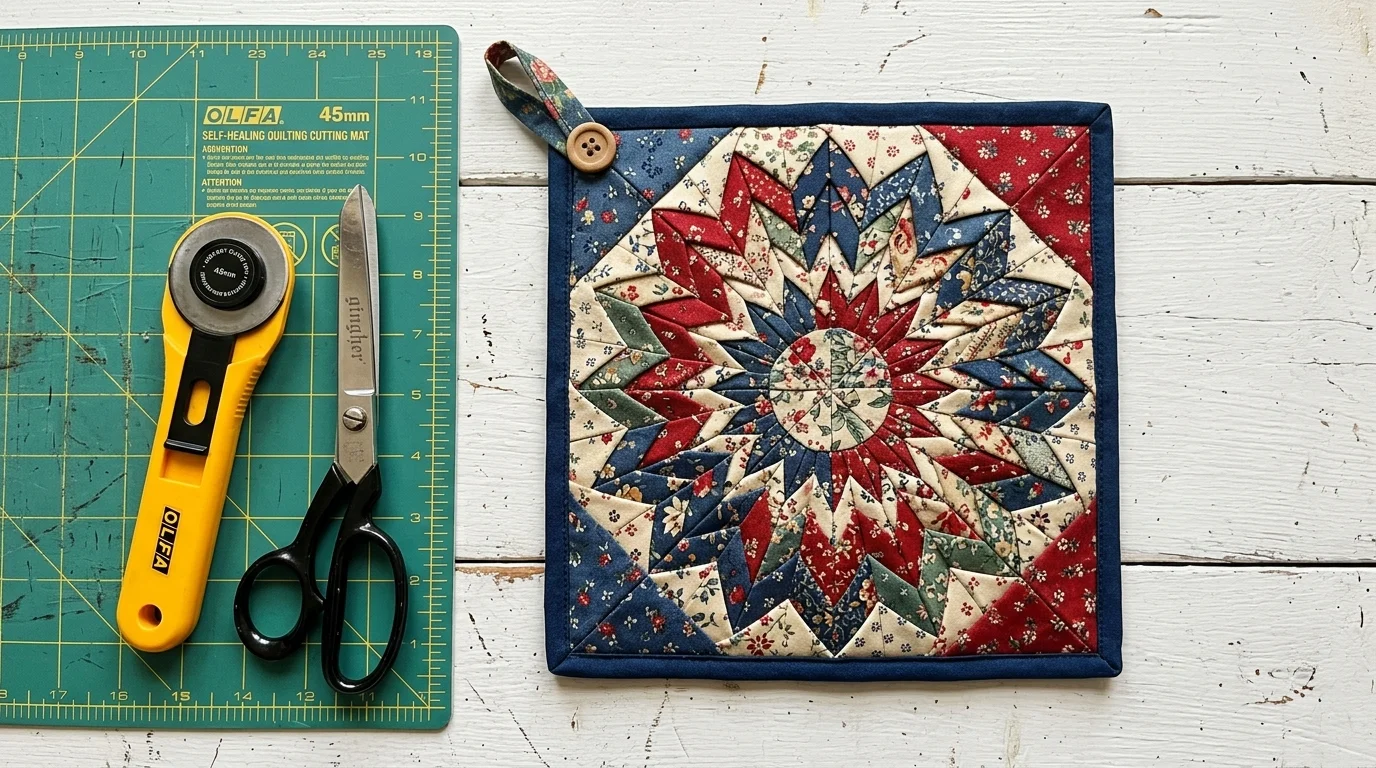
Flat lay of a finished handmade folded star quilt block hot pad with rotary cutter and scissors
Quilt Block Master
Quilting Search Node: 230/mo Volume 8-Point Radial Star
Project Specifications
Free Step-by-Step Guide
YARN WEIGHT 100% Quilting Cotton Prints
HOOK SIZE Rotary Cutter & 45mm Blade
FINISHED SIZE 8.5″ × 8.5″ Square Hot Pad
SKILL LEVEL Intermediate Maker
ESTIMATED YARDAGE Fat Quarter Bundle or Scraps
SAFETY EYES Insul-Bright Heat Shield Batting

Fabric Cutting Specs, Centerpiece Grids & Prairie Point Folding

Position #0 Direct Answer

The folded star quilt block tutorial guides quilters and textile crafters through assembling precision dimensional patchwork stars using folded fabric prairie points. By layering geometric calico prints around an eight-point circular grid, makers create textured hot pads, potholders, pillows, and heirloom quilt centerpieces without raw exposed seams.

The Folded Star Quilt Block (historically celebrated in Patchwork Quilting as the Somerset star) is one of the most beloved heritage textile techniques. By folding squares of Cotton Calico Fabric into Prairie Points and pinning them along concentric circle guidelines, crafters produce an Eight-Point Radial Star with striking 3D optical symmetry. Explore our free crochet patterns catalog or our crochet pattern amigurumi guide if you wish to embellish your finished quilt block with delicate picot lace edgings.

Accurate rotary cutting is essential for Quilting Geometric Motifs. Each of the 24 point squares must be cut along straight grain lines using a 45mm rotary cutter, an acrylic quilting ruler, and a self-healing mat. Cutting off-grain introduces unwanted bias stretch when folding prairie points, causing the points to ripple or cup unevenly when pressed under a steam iron. Using a 50wt 2-ply long-staple cotton thread ensures flat, low-bulk seams that do not distort the multi-layered patchwork center.

To establish perfect symmetry, draft an eight-spoke radial grid on an 8.5″ square of lightweight unbleached muslin foundation fabric. Use a water-soluble fabric marking pen to draw horizontal, vertical, and two diagonal 45-degree intersecting lines across the center point. Measure and mark three concentric circles outward from the center at radii of 1.0 inch, 1.75 inches, and 2.5 inches. These guide rays ensure each ring of folded triangles aligns with pinpoint geometric accuracy, preventing asymmetrical point drift across finished blocks.

Layering the Star: Concentric Rings & Precision Ironing Guidelines

Tension Calibration
Prevent Sizing Disasters
sts
sts
in
Tension Discrepancy +12.5% Tension is tighter than pattern
Adjusted Stitches Needed 171 sts (+19 sts vs pattern's 152 sts)
Actionable Hook Adjustment: Your stitches are tighter than the designer's gauge. To achieve the correct 38″ finished size without rewriting pattern stitch counts, GO UP 0.5 mm in hook size (e.g. swap from 5.0mm to 5.5mm).
Block Section Cut Dimensions Fabric Placement
Center Square One 4.5″ × 4.5″ square Focal floral or calico print
Round 1 Points Eight 3.5″ × 3.5″ squares Contrasting solid or dark calico
Round 2 Points Eight 3.5″ × 3.5″ squares Medium tonal coordinate print
Round 3 Points Eight 3.5″ × 3.5″ squares Accent bright or light calico
Backing & Batting Two 9″ × 9″ squares 100% cotton + Insul-Bright layer

The 3-Step Prairie Point Fold:

  1. Step 1: Take one 3.5″ square wrong side up. Fold in half horizontally and press.
  2. Step 2: Fold top left and right corners down to meet at bottom center folded edge.
  3. Step 3: Press the resulting triangle firmly with steam. Repeat across all 24 point squares to ensure crisp, clean geometric symmetry throughout your block.

Pressing Secret: Never drag the soleplate of your iron across raw folded edges. Lift and press downward firmly using dry heat. Dragging stretches bias grain and causes points to curve.

Finishing the Block: Hot Pad Insul-Bright Backing & Quilt Border Framing

Once all three concentric rings are pinned and stay-stitched around the perimeter 1/8″ from the raw edge, trim the block into a tidy 8.5″ square. For making a functional Hot Pad Pot Holder, thermal engineering is critical: never use synthetic polyester fleece batting, as hot cookware will melt synthetic fibers. Instead, layer one sheet of Insul-Bright Heat Resistant Batting paired with one layer of 100% natural preshrunk cotton batting.

Position the Insul-Bright metallic reflective side facing outward toward the star block to reflect radiant oven temperatures away from your kitchen countertop. Sandwich the layers: backing fabric right side down, cotton batting, Insul-Bright, and the stay-stitched star block right side up. Baste the sandwich using safety pins or basting glue.

Bind the outer edges with standard 2.25″ double-fold binding tape, stitching through all layers with a walking foot to prevent fabric shifting under the needle. Miter the corners cleanly at 45 degrees, fold a small 4-inch matching fabric loop into the upper corner for wall hanging, and hand-stitch the binding fold to the backing using a blind ladder stitch.

If framing your folded star as an heirloom wall quilt or pillow medallion instead of a kitchen trivet, omit the thermal batting and substitute standard lightweight low-loft bamboo batting. Quilt 1/4″ outside the outer prairie points to anchor the center without flattening the delicate three-dimensional calico peaks.

Laundering, Care & Restoring Crisp Prairie Point Folds

When cleaning handmade folded star hot pads, hand wash in lukewarm water with gentle quilt soap or run on a delicate cold machine cycle inside a mesh laundry bag. Never wring or twist the block, as aggressive torque can permanently bend the internal prairie points out of alignment. Lay flat on a clean dry towel and pat into shape to air dry.

To restore the crisp, tactile 3D ridges after repeated washing, spritz lightly with a fine mist of fabric sizing or starch flattener. Using the pointed tip of an iron set to medium cotton heat with steam turned off, gently press each individual triangle from the outer ring toward the center circle. The sharp dry heat reactivates the cotton fibers, returning your star to museum-grade display stiffness and pristine dimensional contrast.

Geometric Quilting Companions: Ribbon Stars & Scrap-Busting Blocks

Vintage Geometric Crafting Silo

Love modular geometric handcrafts? Discover our matching vintage crochet square bag tutorial to build heirloom checkerboard cotton accessories with zero waste, or check our crochet baby vest pattern.

View Battenberg Bag Pattern →

Frequently Asked Questions About Making Folded Star Quilt Blocks

What fabric is best for folded star quilt blocks?

100% quilting cotton or fine calico prints are ideal. High-thread-count cotton holds sharp, crisp pressed creases without fraying, which is vital when layering multiple prairie points around the star center.

What heat-resistant batting should I use for a folded star hot pad?

Use one layer of Insul-Bright heat-reflective metallic batting paired with one layer of 100% natural cotton batting. The metallic layer reflects radiant oven heat, while cotton absorbs ambient steam.

How do I ensure my star points line up symmetrically?

Draw an eight-point radial grid on your foundation square (horizontal, vertical, and two 45-degree diagonal intersecting lines). Align the folded center point of each prairie point directly along these marked guide rays.

Can I wash a folded star quilt block?

Yes, machine wash on delicate cold cycle with mild detergent and lay flat to dry. A gentle warm steam press restores the crisp 3D folds after laundering.

```